GEEKERY  
ADVENTURE  
CONTEMPLATION  

20111029

bang for your buck, decision fatigue, and getting what you want

It's snowing like crazy right now, and already starting to accumulate, which is odd because it hasn't accumulated more than an inch of snow here in October since the Civil War. N is prancing about like a delighted little demon child. But I'm not here to talk about the weather.

I went to the local artisan quilt store yesterday because I was in the area anyway and knew that they were having a sale. A bit ago, I purchased a lovely alphabet quilt pattern with all sorts of animal on it, which requires a million different colors in small swatches, so I figured that this would be a good time to stock up of bits and piece for that quilt. I spent an hour in the store comparing this to that, and trying to figure out how much I should buy. At one point, I had sixty dollars of fat quarters in my arms, intending to buy them all. But then I decided that I was being ridiculous and that I should only get what I really loved and would regret not buying for that quilt. I cut the number down to a third, checked out, and left quickly--I was tired of making decisions.

I hit the grocery store immediately afterward, and when I got home, I made a to-do list then took a nap and didn't really do anything on my list until after dinner. School has been depleting me of late, and this was my first chance to relax in a while.

That whole experience got me thinking: I had infinite time and energy, what decisions would I make when it comes to consumption? How do I train myself to make good decisions always? The answer is in the last line of the previously linked article: "The best decision makers," Baumeister says, "are the ones who know when not to trust themselves."

My default used to be purchase something over leaving it behind, but now I've reversed that, and I think that that's a good policy for everyone.  It's the state of no change, and decisions can be made later.  Return policies complicate things, of course, as do annoyingly overwhelming salespeople, to whom I've fallen victim a few times.  

And then there's the need to keep glucose levels appropriately high for good decision-making.  Making decisions aside, I know I'm happier in general when I adopt a hummingbird diet, as my mom calls it: eating tiny portions near constantly.  Part of me wonders if there could be a system where a credit card charge would require a glucose check of its owner in addition to a signature.   I doubt that the credit cards or the retailers would want that, though.

In the end, list-making works best for me.  I make a list when I'm capable of making good decisions and then I need to make fewer choices at the store, as long as I stick to the list.  Knowing the product brands in advance is really nice too, which can usually be done online, even for grocery stores.  Part of the reason the quilt store was so exhausting was that my list looked like "1/2 yard of a variety of green fabrics for alligators, newts, and turtles," which requires in-store decision making.  It would be the equivalent of saying "spices for roast chicken" or "a few veggies for stir-fry" instead of "rosemary, thyme" or "carrots, bell peppers, mushrooms."

 Then there's the question of how much to get of any given item, be it fabric, food, or any other "consumable"--something you'll use up eventually.  I could buy a full yard fo green fabric, but will I actually ever use it?  How about getting my toilet paper in bulk?  Getting the most per dollar is important, but it's not always clear what to do.  Say you need one unit of product A and that goes for  $1.  You could also get 10 units of product A for $8.  Well, if you're going to use all ten units eventually and you have both the budget leeway and the storage space, then 10/$8 makes more sense.  Toilet paper, for instance would be an example of this type of product.  But if you might only ever use 5 units of product A and the rest will just sit there, then it's best to only buy what you need.  For me, lots of green fabric would fall into this category.  I'd use some of it, probably even more than the original 1 unit I needed, but probably not all of it.  If I only used 5 units, I would have really paid $8/5 units, which would be more than the $1/1 unit.

It's this second category of item that is really tricky, since you don't know how much you're going to use in advance.  For me, I error on the side of buying only the smallest unit that I need, or $1/1 unit in the case above.  Even if I have to go back and buy more of the product later, it's worth it to spending a little extra to only have exactly what I need at any given time.  When I choose not to buy in bulk, I think of the extra cost as a minimization fee--I'm willing to pay a little more so I don't have to worry about a lot of stuff.

I'm not always the wisest consumer, but I feel like I'm getting better.  In some ways I am a materialist in that I think about physical objects and how they impact our lives; I had the realization recently that conscious minimalism is a kind of materialism.  That's not to say that material things are more important than non-material things--quite the reverse in my opinion--but that material things are important, that they have value, and they are worth thought.  Unnecessary consumption seems a little vulgar, though I am certainly guilty of it.  But I'm walking down a tangent line.

The end point: make good decisions by eating well and making up your mind in advance when you can.  This can work for more than just being a consumer and is actually part of the GTD system in a way; sometimes it's easier to do something than to think or make plans about doing it.

20110706

takin' it in

My mom went shopping with my Grandma recently (mom swore that gma hadn't renovated her wardrobe for something like twenty years) and in retelling the happenings to me, mom said that Grandma had small shoulders and in pointing this out to her, Grandma had responded, "Oh, I've always had small shoulders, I'm used to taking them in." (Or something to that effect.)

Since I have a pretty standard body, or at least one that doesn't need much tailoring with modern fashions, this kind of blew my mind; my grandma had altered her clothing all her life, and not in the I-pay-someone-to-do-it-for-me kind of way.  She's so awesome.

Alright, now for a tangent: N and I got called to be ordinance workers at the LDS Manhattan Temple this weekend and we need all-white attire for the job.  I was fine since I got temple clothes a bit ago, but N needed to piece together his outfit.  Sometime last year we picked up a white dress shirt for him at Costco, but it turned out to be a little big around the waist and thus it puffed awkwardly in the back when it was tucked in.

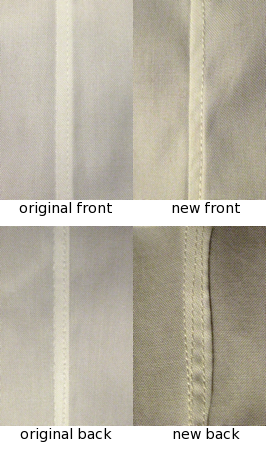
Having recently heard the above Grandma story and faced with the need for a white dress shirt, I decided to try to take in N's Costco shirt.  It was the most complicated alteration I've ever done and it didn't go over too badly. (Most of my past stuff has just been hemming which is pretty much straight lines.)

Here are the gory details via photo documentation, including a very messy interior/back (what do you call the side that goes towards the body?). And don't tell me it's not messy, 'cause I cherrypicked the nicest part...you don't wanna see the bad parts and you're never gunna have to, so there.  It fits him nicely, which is the important part.

20101019

using raw veggies

Sometime last week I discovered that I had let a bundle of parsley start to wilt.  I had wanted to make pasta dish that night, so I decided to make a pesto.  Puréed parsley with a little olive oil was too strong on the parsley flavor, so I added carrots and a few mushrooms to the food processor to smooth it out.  I spiced it to taste and tossed it with thin spaghetti and it was a success with leftovers to spare.  Greens saved from wasting and dinner served.

Then on Sunday, we had the LDS missionaries over and I made dinner for them: arugula salad, black bean soup, and stuffed acorn squash.  The stuffing was a quinoa-wild rice pilaf with cooked onions, shredded carrots and zucchini, and halved grape tomatoes.  One of the missionaries paid me a complement when he said "I just realized what I'm eating.  You know those magazines with the food that looks really good and is good for you?  That's what I'm eating."

The common thread between the two dinners was that they both used a fair amount of raw vegetables in the main dish.  I'm familiar with various raw-foods diets and am far from that myself, but I think it would be a good thing to incorporate more raw food into my meal preparations.  Cooked food is nutrient-dense and allows us to eat good food inexpensively--rice, beans, potatoes, bread--but adding raw foods will increase the diversity of our diets.  Briefly looking at raw-food recipes online, it seems that apple, avocado, carrots, coconut, and nuts are fairly popular, but of course any veggies or fruits can work.  I've been intrigued with apples in savory dishes for a while, so perhaps I can try a raw twist to that.  It'll be a fun vein to explore.

20100708

adventures in dyhrdating food

As N and I prepare to do the JMT, we've been dehydrating our own fruits, veggies, and meats to make our loads as light as possible for as cheaply as possible.  It takes forever, but it's much more fun (at least for me) and healthy to pack one's own meals rather than use store-bought packs.  Almost everything I'm packing just needs to be boiled or soaked in water and it's good to go.

We're planning on mailing half of our food to a midway point along the trail; they'll hold it for a small fee.  On average, these meals still cost more than our usual meals as they contain much more meat and have bigger portions, but I think we've kept costs down pretty well.

20100624

kitchen dregs

Last night I was tired and not in the mood to cook anything.  I didn't really have anything good in the fridge either...a few old and rotting vegetables, some broth, leftover enchilada sauce, and a small amount of monterey jack cheese.

Weighing a too-soft zucchini in one hand and a wrinkly red bell pepper in the other, I had an idea that was crazy enough to make me want to cook again.  I rummaged for an ancient onion in the back of the cupboard and pulled down my masa mix.

Corn masa, for those that don't know, is used to make corn tortillas, tamales, and pupusas.  And I decided to try and make Masa-ball soup (inspired by matzah-ball soup).

I sautéed the onion and added the chopped-up bell pepper and zucchini (with the bad parts cut out).  Part of the trick with aging vegetables is to cook them until they are soft enough that you can't tell they were wilted in the first place--soups are excellent for this.

I added the chicken broth I had on hand, and some water (and salt) to add more volume.  Then came my favorite part: adding a few spoonfuls of the leftover red enchilada sauce!  This gave it the perfect flavor.

The masa balls I made were much smaller than typical matzah-balls, mostly because I knew the masa was going to be denser.  I think it would have been better if I had added eggs to the masa (which is usually just the mix and water, sometimes with a little oil too) to lighten it up, but I didn't have any on hand.  I could have also made tortillas and fried them, but masa-balls were so much simpler, faster, and more puny.

I dropped the masa-balls into the soup and cooked them until they floated and served the whole shebang topped with grated cheese.  And it was pretty darn good.  I love finding ways to use the dregs in my kitchen.

20091105

buying bread vs. making bread

I've been struggling with the dilemma of whether to buy bread or bake bread. Home-made bread tends to be healthier and is obviously more fresh. It can be tastier too, if you're skilled enough, which just comes with time. However, it takes much more time and energy to bake a loaf than it does to go out and buy one (unless you live quite far from a store and consider it exceptionally difficult to deal with the check-out personnel). Unable to make a conclusion, I decided to run some numbers to see which was cheaper, and I thought I'd share.


The cost of buying bread every week is basically $2.50/loaf for Oroweat 100% Whole Wheat Bread from Safeway. I'd factor in transportation, but I go to the store just as much, whether my bread is bought or baked. That one loaf of bread is 1620 calories, which brings it to .154 cents per calorie.


The cost of making bread is a little more complicated. There are a million permutations, but I'll just consider two: buying your yeast and keeping a yeast starter.  Also note that I'm not counting the cost of water.


Weekly bread ingredients: packaged yeast: $0.44, 1.25 lb flour = $1.12, 2T honey = $0.25
Calories: 2200 calories

This comes to about .082 cents per calorie.  Additionally, you can factor in your time into the cost, but I enjoy baking enough not to do that.


Weekly yeast maintenance: .25 lb flour = $0.22
Weekly bread ingredients: 1lb flour = $0.90, 2T honey = $0.25
Calories: 2200 calories

Once you get the routine going, it comes to .062 cents per calorie. There is a startup cost of getting your yeast going, but you might be able to find someone to give you some of theirs to start. 


It's hard to grasp the cost of things when we're talking fractions of cents, but think of it this way: an individual consumes about 14000 calories a week.  If one-tenth of your caloric intake comes from bread, the difference between buying bread and baking bread is about $1.29 a week, or $67 a year.  If half of your caloric intake is from bread, it comes to $6.44 a week, or $335 a year.  It's counting pennies, but more information never hurts.

As for me, I'm going to see if I can get a yeast starter going.

20080825

Nearly Rotten Apples

I had four wonderful Pink Lady apples which I nearly let go bad in my fridge. Upon cutting them open, I discovered that they were beginning to brown ever so slightly. This made them less than appetizing to eat raw, but they worked really well in an apple crumble! I cut them into half inch blocks, getting rid of the skin, cores, are rotten bits, of course, and tossed them with 1/8 cup sugar, a teaspoon or so of cinnamon (perhaps more, to taste), and some fresh squeezed orange juice from about a quarter of an orange. The crumble itself I adapted from The New Best Recipe: 1/8 c packed brown sugar, 2.5 Tbs butter 1/8 c white sugar, 1/4 tsp cinnamon, 1/2 cup flour, and 3/8 c coarsely chopped nuts (I used half pecans half almonds). I used a food processor to mix all but the nuts until sandy and then pulsed the nuts in until they were mixed and chopped a little finer. I baked the whole thing in six ramekins at 375 until the tops started to brown. I ate four of the six by bedtime. A simple margarine for butter substitution makes the recipe vegan.