I was switching out the bobbin on my sewing machine, and looking for a white cotton one to match my new thread. The problem was that I have two white threads: cotton and polyester. Which one was in the bobbin? I couldn't tell just by looking at it.
So I whipped out the matchbox and performed the tried-and-true
burn test. Anyone who's familiar with textiles knows that natural fibers like cotton and wool burn, but synthetic ones melt into a little blob. The thread on my bobbin burned, proving it cotton, and I went merrily on my way.
But then later I found myself asking: why do natural fibers burn but synthetic ones don't? Surely there must be a chemical reason. Digging around on Wikipedia didn't reveal any easy answers.
First of all, let's lay down some definitions:
natural fibers come from
plant,
animal or
mineral sources. Common examples of plant fibers are cotton, linen (via flax), and hemp. Animal fibers come from a variety of mammals including sheep, goats, alpaca, and rabbits for wool and fur. Silks are also animal fibers, and come from animals like
silkworms and
clams. The most well known mineral fiber is asbestos; mineral fibers aren't used for textiles.
Man-made fibers break down into roughly two categories: regenerated and synthetic. You'll see the word artificial used as well, but it seems to have an ambiguous meaning. Anyway,
synthetic fibers come from chemical reactions. All the sources I've read talk about extrusion, but I think this is best explained with an example.
When I took organic chemistry, we synthesized nylon. The very basic idea is that you have two chemicals, one floating on top of the other. In between, a reaction creates nylon. If you pull the nylon out, more nylon will be created, giving us a nylon thread.
Here's a video example. I imagine fancy machinery does this at a smaller scale to create the stuff we use regularly.
My understanding is that
regenerated fiber is created with basically the same process, except one of the chemicals is a cellulose pulp from a natural source, like wood, bamboo, or seaweed.
Rayon, an "artificial silk," is one of the most common fibers of this kind, and is made from wood.
Now let's get back to the burn test. Natural fibers burn in various ways, synthetic fibers melt, and regenerated fibers burn a little and melt a little—not terribly surprising. But why does the distinction exist in the first place?
Cotton, linen, and other plant fibers are made mostly of
cellulose, which has the ring-like structure shown below. When cellulose burns, it takes in oxygen and puts out carbon dioxide and water. As a balanced chemical equation: C
6H
10O
5 + 6O
2 --heat--> 6CO
2 + 5H
2O. The output are gasses, so they just float away.
Ash that remains from burning anything is mostly made up of metal oxides, so I'm guessing it comes from the non-cellulose bits.
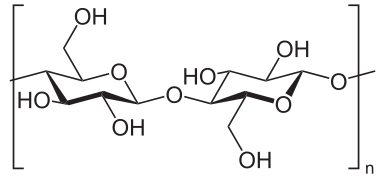 |
| Cellulose, via Wikipedia. |
Animal fibers are made of more complicated proteins made from carbon, hydrogen, oxygen, nitrogen and sulfur and are called
polyamides. I'm imagining that they have similar (if more complex) chemical reactions that result in carbon dioxide, water, and other gases, as well as ash. Nitrogen gas (N
2) is common in the atmosphere, and Ammonia, or NH
3 might explain the odor associated with burning animal fibers. Hydrogen sulfide (H
2S) also has a bad smell.
Nylon is also a polyamide. It contains a fair amount of nitrogen, and burning it produces the dangerous
hydrogen cyanide. What I really want to understand is the following line (from the
nylon Wikipedia page) on the chemical structure of nylon: "The direction of the
amide bond reverses between each monomer, unlike natural
polyamide proteins which have overall directionality:
C terminal →
N terminal." I have only a vague idea what it means, and no idea if it's even relevant.
Really, I just need to corner a chemist and harass them until they give me some straight answers. Or find a resource on the chemical reactions involved in burning wool, nylon, and rayon. So far, I've no luck.

