GEEKERY  
ADVENTURE  
CONTEMPLATION  

20140924

In favor of "BigLaw"

Last Friday, my amazing little brother published an article in the Harvard Law Record entitled Want to Save the World? Do BigLaw! which has had mixed reception, including a rebuttal that was published in conjunction with it.

My brother has an intentionally inflammatory style for humor (see also: our childhood), but his point was this: if you can withstand the indulgent aspects of corporate culture, then you can do more good by making lots of money and donating it to effective charities than you can by donating your career to particular causes.

While I think that there always individual exceptions, I agree with his analysis.  The market has greater capacity for corporate lawyers than for public interest or government positions.  Additionally, the scope of influence for the latter two is usually limited to the nation in which the individual practices.  In the case of American public interest lawyers, the people benefiting from their services are usually American citizens or residents (legal or otherwise).

In all countries there are marginalized populations; these people deserve advocacy and legal protection.  However, if citizens of a nation wait until all of their fellow residents are happy and healthy before they look outside their own country to do good, then they will likely be waiting indefinitely.

The US is incredibly privileged.  We still have problems, but citizens of many, many other countries have it much, much worse off than even the poorest among us here.  We can choose to pay $3 for someone's lunch in America, or spend that same money on a Malaria net that saves a child's life [1].  It simply comes down to the most effective allotment of resources.  (And requires thinking globally instead of nationally.)

In the case of law, I think the numbers work out in favor of practicing corporate law and donating a percentage of your income.  Everyone must make their own choices, but I think if more people took this path, it wouldn't only be good for the recipients: lawyers practicing this lifestyle might begin to change corporate society, steering it away from consumerism and self-indulgence.


Press for his original article:
Above the Law: What Harvard Law Students Tell Themselves When The Demon Come

[1] Probabilistically, it actually takes more than that to save a life, since not everyone is guaranteed to get malaria; the AMF puts the figure at about $2,500/life.  In the US, that could be used for a fancy computer or a vacation.  It's also less than four month's net income for the average US food stamp recipient household.  The average food stamp recipient is gets $133.85/month, or less than $1.50/person/meal.  So the real comparison is helping to feed a family of four (in the US) for a little over a year vs. saving a life.  It's not so cut and dry, but I think the life still wins.

20140911

9/11 in NY

Today I was up in New York on regular business—reading group and my lab's group meeting.  When I arrived at Columbia, the main walk was covered in hundreds if not thousands of small American flags, and I remembered the date.  Throughout the day, it got lots of attention: people took pictures and there was even a pro-Palestine rally of some kind.

I was safely in California thirteen years ago, but I still remember waking up to the news and sitting on my parent's bed watching the smoke.  When a peer said that there was another attack at the Pentagon, I thought he was just trying to get attention.  So I was a little solemn today, as it made things a little more real, knowing that some percentage of the people around me had lived through the event in the city.

But then I witnessed something bizarre during the afternoon: a young woman plucking a handful of flags and then tossing them in the garbage with apparent distain.  I didn't know what to make of it.  Was she anti-American?  Was she an American citizen?  Was her family or her home country harmed by the US?  Was she somehow against the display of flags?  Did she lose family in 9/11 and was frustrated by the reminder?  It remains a mystery.

20140825

forever learning

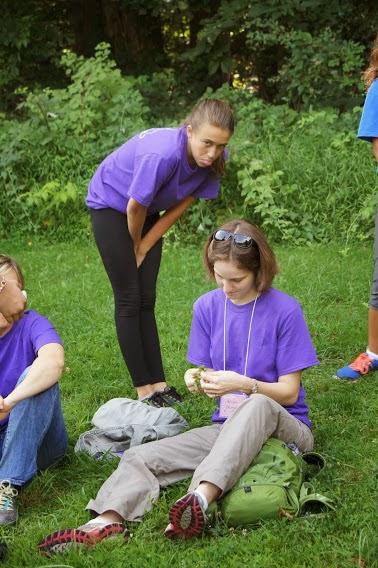
Last week I was a leader for my church's summer girls' camp.  In addition to getting to know the girls better, I felt that I learned a few lessons myself.

As a leader, I needed to ask the girls to do lots of stuff, from cleaning latrines to going on hikes, practicing our skit to heading to dinner. There were times that I dealt out tough love and there were times that I was a softie.  It's a spectrum, of course, and each situation needed to be handled in its own particular way. I usually didn't give it much thought and just went with my gut.

Oblivious me: braiding clover
instead of paying attention.
It was reinforced—and it might be an obvious lesson to other people—that not only is every situation different, but every individual is unique as well.  I'm not just talking about people having a variety of personalities (I'm not that obtuse), but that every person has their own history of experiences and circumstances that shapes them. People might react differently due to physical or mental illness, or traumatic experiences that they have had in their lives.  These are obviously extreme examples, but even a relatively common situation, like a break-up with a boyfriend or bad grades in school, can cause a shift in a person's mind and attitude.

A difficult thing with teenagers is that they're starting to be affected by longer-term problems pretty consistently—it seems like they carry their emotions and memories for longer periods of time. Additionally, teenagers are mature enough to keep bigger secrets, and so leaders don't necessarily know what's going on in their lives behind-the-scenes. These things wouldn't be an issue for me if I wasn't expected to keep them on track in various ways. They aren't mature enough to take care of themselves and their responsibilities completely.

Even when I'm not coaxing people to do things, I often judge them without knowing their situation.  She's buying that for her kids?  Did he really just say that?  I know it's not right, but I try not to let it show.  I also try not to be judgmental in the first place, but not letting it show is the first step.  It's harder when you need to take action in conjunction with your judgements.  For guiding people to action, it's about finding the right set point between sympathetic and severe, and it's rarely in the same place twice, even for the same person.

I didn't make any horrific mistakes at camp, but I felt like I made lots of small ones. I can't imagine what it's like to be a parent. Thankfully, the girls were incredibly forgiving, and taught me to be a little bit better all around.

20140513

forgiving vs. condoning

Elder Holland's General Conference talk in April struck me with the following passage.
At the zenith of His mortal ministry, Jesus said, “Love one another, as I have loved you.” [John 15:12] To make certain they understood exactly what kind of love that was, He said, “If ye love me, keep my commandments” [John 14:15] and “whosoever … shall break one of [the] least commandments, and shall teach men so, he shall be … the least in the kingdom of heaven.” [Matthew 5:19]  Christlike love is the greatest need we have on this planet in part because righteousness was always supposed to accompany it. So if love is to be our watchword, as it must be, then by the word of Him who is love personified, we must forsake transgression and any hint of advocacy for it in others.  Jesus clearly understood what many in our modern culture seem to forget: that there is a crucial difference between the commandment to forgive sin (which He had an infinite capacity to do) and the warning against condoning it (which He never ever did even once).
I have often supported or encouraged in others things that I would not accept for myself. Sometimes I feel like this is okay, and sometimes it falls into "condoning sin."

Let's start with a softball example: pierced ears. Paul taught that the body is a temple (among lots of other crazy stuff), and the LDS church has discouraged piercings and tattoos, with the exception that it's okay for women to have one earring in each ear.  I don't have any piercings, nor do I want any, but I have no problem buying earrings for people, or complimenting earrings.  Honestly, I think non-traditional piercings and tattoos can also be very tasteful.  Simply put, I'm condoning things that I wouldn't accept for myself.  But the things I'm condoning aren't really a sin, I just have a weird thing against body modification for myself.  It's one of the thing I'm compulsive about: I can't even draw on myself with pen and not be scrubbing it off within a few minutes.

Alright, so the easy stuff is over; let's move right on over to the difficult and sensitive issues: gay marriage and sex outside of marriage.  I'm supportive of gay marriage rights. I'm also supportive of my friends who have sex outside of marriage.  But should I be?  I have no idea.  I don't really know what is sinful and what isn't—this is the crux of the problem.  On some level I just don't care about the details of personal choices my friends are making.  Mostly, I don't want them to feel judged constantly whenever they talk about their partner and I want to keep being their friends.  If I don't say anything supportive, they might very well presume I'm stewing in religious judgement, which I'm not.  For me, it really is as simple as the pierced ears example: I'm not going to do it myself, but I think other people can be happy with different choices.

For less complicated issues, I might think that people could be happier with alternative choices.  If they asked my advice, I'd probably guide them according to my personal morals.  But on socially charged topics, it's really hard to disentangle the "sin" from the "sinner."  If a dear friend is gay, how can you possibly tell them in love that you disapprove of them having any kind of romantic relationship?  Are you just supposed to let it sit there awkwardly?

I can't forgive friends for certain things (like being gay) because there is nothing to forgive.  They haven't wronged me in any way and it's not my place to pass judgement. For this same reason I cannot condone or condemn their actions.  I trust people to choose the best path for themselves.  I will give advice when asked and will try to be supportive of them as individuals.  If I am guilty of condoning sin, it is because I think everyone should have the choice to determine for themselves what qualifies as sin.  I'm certainly still figuring it out for myself.

While I seem to be dismissing Elder Holland's remarks, I still am rolling them around in my mind and heart.  In particular, there are certainly times that I fake approval of other people's choices (trivial or otherwise) because I'm a people-pleaser.  The real thing that I've internalized from his comments is to stop that behavior; I should just be honest about my reactions to things.  If I don't like the way that skirt looks, I shouldn't say I do and encourage my friend to buy it because she likes it.  If I don't think a particular couple should move in together, I shouldn't fake my support because I'm worried that they'll think I'm being judgmental otherwise.  I should have confidence in my opinions and stop trying to say what other people want to hear.

20140219

street manners

We were in Manhattan recently and I had one of those short experiences that left me intensely frustrated and wishing that I was more quick with my tongue.

We were turning left on a crowded sidewalk and staying to the left until there was space to walk elsewhere, since you can't very well teleport across the sidewalk. Then, an older lady encountered NWC, who was walking in front of me, and said with what seemed like all the venom she could muster: "You're supposed to walk on the right, Stupid." I paused, and turned and saying, "Excuse me ma'am." I wanted to say that there was no excuse to be that mean about it. She had behaved like a five year old, calling people names.

She had passed, but another older lady, presumably her friend, turned as well to say something to the effect of: "No, she's right, there are protocols." My objection wasn't to her correction, but to her rudeness. Yes, there are protocols, but the purpose of them is to be polite, which she violated in spades. Everyone walks on the left side occasionally. But, of course, I couldn't come up with the right thing to say as quickly as needed (I managed to stammer out "We were just..."), so I just threw my hands up and rolled my eyes before diving back into the crowd.  Mine was a seven-year old response, besting her in maturity by all of two years, and not making my point in the slightest.

So I'll make my point now: the purpose of courtesy rules is to be courteous.  If people violate them, be polite, and possibly firm, in your corrections.  You may argue that the purpose of these norms is to speed up transit, etc., and those are good side effects, but never of such great value to permit rudeness.

20140103

magnificent people

I don't often remember dreams, but when I do, they're either bizarre, or they're about random people I know or have known in real life.  The acquaintances that I remember from my dreams are usually people I think about in a certain way.

They are the people that I wish I had known better, the ones that stood out in some way.  Perhaps they were (and hopefully still are) particularly articulate, accomplished, or self-aware.  Often they seemed to possess some kind of wisdom.  They are magnificent specimens of the human race.

I don't usually like to talk about my admiration for these people because it could easily be taken the wrong way, but I'd be remiss if I didn't admit that I do love them in the agape sense of the word.  I've recently realized, however, that the problem isn't in feeling this divine-type love for people.  Rather, it's in not feeling it for everyone else.

It's easy to love beauty, be it physical or intellectual.  It is much harder to cultivate love for people that are boring in some sense.  It's also easy to love from afar; when you interact more closely with people, you see the dirt under their fingernails.  From there, it's easy to put them in a box with everyone else who has dirt under their fingernails.

I have no solution for now, but I think this realization it helpful in itself.  At the very least, this awareness can be used to help transfer some of my respect from the magnificent people to the mundane.

20131119

the guy at the gate: a confession

A week ago, I was driving and took a wrong turn and ended up heading toward the university gates after hours.  I figured it would be easier to go through campus than turn around, and so I showed the guy at the gate my id, and he asked me where I was going.  For some reason, I just lied on the spot and told him I was picking up a friend at the "athletic center."  He gave me a funny look, and was like, the gym?  I told him again that I was a student and rattled off some stuff that only a student would know. Then he says, more or less, Well, that can all be true, but it doesn't seem like you know where you're going.  At that point, I'm mad about being caught in a lie and I turn around.

I'm not the kind of person who lies about stupid stuff like this. I try not to be the kind of person who lies at all. I felt and still feel terrible abut the whole thing. It's hanging with me much longer than I ever thought it would.

What baffles me is that for a while I was mad at the guard for not letting me in.  If I were actually picking up a friend at the gym, I might very well have done the exact same thing because I often forget the proper names of things and turn to descriptions of them instead.  Pass me the writing thingummie. Where did you put the scooper for soup?  If I were actually caught in a situation where they weren't letting me in and I had a reason to be there, I don't know what I would have done differently.  Maybe provide the details of what the friend was doing?

The truth is I made a mistake and instead of dealing with the mistake, I chose to complicate the situation by fabricating a story.  I could have just told the guard that I made a mistake.  The thing is, I know they don't allow through traffic after hours, and there are places to turn around far before the guard house, so I should have just turned around as soon as possible and corrected myself.  This could be a metaphor for life, but I'll leave it up to you to iron out the details.

In an odd way, I'm glad it happened.  It's making me thing about bigger things like honesty, taking responsibility, thinking things through, and correcting mistakes.  I couldn't have asked for a kinder situation for a wake-up call.

20130326

you don't understand

Ugh, that title sounds like some awful teenager.  Luckily, there no teenagers in this post.

Today I had the opportunity to listen to a guest lecture by the famous machine learning theorist Vladimir Vapnik.  Since he lives locally, I've heard him talk about the same topic three times now: in this class, at the annual NYAS Machine Learning Symposium, and at general Princeton CS Lecture.  (These are more-or-less the slides he used today.)

Warning: this next paragraph is geeky; skip it if you aren't interested.
The theory he presents is interesting, as are the results; he proposes that information other than input and result can be used in training a machine learning algorithm.  The idea is that some description of how we get from input to output, even if the description isn't enough to reproduce the result exactly, helps us learn.   He gives an awesome example of labeling OCR numbers with essentially poetry, describing the personalities of the writers in flowery, adjective-heavy text; each digit in the training set had some text written exclusively for it. He shows that providing that text when training the algorithm (in addition to the input pixels and labeled outputs, of course) results in better OCR recognition than just providing the standard training data exclusively.  Permuting the text associations got rid of the improvement. Crazy stuff.

During the lecture, he said to the class several times "you don't understand."  It wasn't a question, nor did he always attempt to re-explain, perhaps deeming us incapable of understanding those particular points at all.  I've often found that the most brilliant people have a hard time explaining themselves so that everyone can understand--they just can't understand not understanding, and so can't see the path people need to follow in order to obtain understanding.

It seemed like Vapnik has reached a point in his life were he is comfortable with people not understanding him; he's a very well-established individual and is possibly entitled to that luxury.  At this point, it's on us to try and understand him, instead of the usual more balanced responsibilities of teacher and student both needing to do their best to teach and understand, respectively.

That isn't to say that Vapnik isn't a good lecturer; he's fairly clear and entertaining, but there are some details that could use more illumination.  Perhaps I'm not being fair, though, since everything is in contrast to the usual lecturer for the course Rob Schapire, who is possibly the best lecturer I've ever encountered.  I also contrast it to my own teaching, where I've been thinking hard about how to explain simple computer science concepts like objects or static methods to students that have never seen the material or anything like it ever before.  It's a lot of fun, but it's also exhausting to some extent.

Anyway, I find it funny that I felt the need to write a commentary about the teaching style of the lecturer whose talk was entitled Learning with Teacher: Learning using Hidden Information.  Maybe there was something hidden in there...

20130203

knowledge vs. belief

It's very common for Mormons to say "I know ___," as in "I know the church is true," or "I know that Christ is my Savior."  Today, we had a man stand up and shamefully declared that he didn't know, but that he believed, and it was one of the most touching expression of faith that I've heard in a good long while.

We also had an investigator sitting near us today, and after the meeting he asked me what people meant when they said that they knew something that is generally considered to be unknowable.  I told him that it was a way in our culture of expressing that one has had a spiritual experience confirming the belief in question, but that often times we just say I know instead of I believe out of cultural habit.  People simply like the strength implied by knowledge.

I'm somewhat comfortable with this specialized cultural context of knowledge, but my main struggle with this phrasing is that it discourages people that don't know, or that haven't had confirming spiritual experiences.  It's exclusive: you're not in the club because you don't know.  Because of this, the use broadens to cover simple belief as well, making the club more inclusive, but making things even more painful for those who feel they cannot honestly declare knowledge when they have none.

20130131

phone-related commercials + rant

First, there's the Sprint Unlimited commercial.  They feed you lines about how human experience is spectacular, and why would you cap that?  Your phone can capture the entire gallery of humanity, the narrator says, and he needs to upload all of it.  Then he says "I have the need--no, I have the right to be unlimited."

No, actually, you don't have the right to an unlimited cell phone plan.   You aren't entitled to anything when it comes to that type of discretionary technology.  You don't even have the right to read technical papers that your tax payer money has funded.  And it's great that your phone can capture everything (which I'm not so sure about, but let's run with it), however, unless you're working on a documentary, you should probably live your life rather than record it all.

Then, we have the Droid DNA ad, showing a man's blood, DNA, and neurons being taken over by his cell phone.  It culminates in the line: "It's not an upgrade to your phone, it's an upgrade to yourself."

No, no, it's not.  Frankly, being obsessed with using your phone might downgrade you as a person.  My question is: why is texting or browsing the web in the social context even okay to begin with?  You wouldn't take a non-urgent phone call in the middle of a conversation with another person, nor would you open up a newspaper in the middle of a class.  Why are people so rude?

Etiquette aside, why are we obsessed with the online world?  Why do people have the patience to use Pinterest regularly?  How do people the have the endurance to tweet or check for Facebook updates continually?  To me, so much of it feels like noise that's getting in the way of the things that I really care about.

I love the internet.  I love being able to look things up, sync my files, and blog.  But I have no desire to be constantly plugged into the online world. I have no desire for a smartphone. I love making things more than reading about making things. I love working uninterrupted. I love paper maps, even though I can get terribly lost. Getting lost is half the fun.

So while the age threshold for people with nicer phones than me drops into the tweens, I'm declaring my right to limit myself.  I don't need unlimited online access, and I'm more productive, learn more, and am more engaged with the world without it.

20121220

the things I didn't write about

It's been a while since I posed anything.  I got stuck on my diatribe about digital barbarism, and then a bunch of stuff happened, personal and otherwise.

In the personal arena, I attended NIPS, drowned in coursework, and was elected garden coordinator for our apartment community.

Then there was the hullabaloo about Mormon women wearing pants.  I participated in a cowardly manner by wearing my baggy skirt-like harem/jeanie/Aladdin pants.

Locally, Sandy has still displaced way too many people, and we're still working on gutting homes so mold can be prevented before they start to rebuild.

And then Newton.  I cried several days in a row.  I know that there are worse things abroad and to some degree it's selfish to focus on how terrible it was when other equally bad things get very little attention.  But it felt more personal; it's a two-and-a-half hour drive from where I live and the states are all so close culturally, it felt like it could have been my own town.  An emotional reaction, rather than a logical one, I know, but I'm not a robot.  A lot of people are suffering, in Newtown and elsewhere, and they have my prayers.

20121123

Three Years Late: A Lengthy Review of Mark Helprin's Digital Barbarism, Part 3

This is part 3 of multi-part series; things will make more sense if you start at the first post.

Intellectual Barbarism

The public reaction to Helprin's article was incredibly negative, with an almost barbaric approach in the comments--hence the title of the book. His discovery of this side of humanity shocked and appalled him, and rightfully so. Unfortunately, I feel that Helprin, in an understandable emotional reaction to such negative feedback, swept far to many people under the label of savages.

Certainly individuals bare their teeth when they are allowed to hide behind a veil on anonymity--we see this all the time.  Online media allows people to speak (or write, really) before thinking, or the occasionally worse: speak without having anything to say.

As Helprin points out, people often don't read things in full (or at all) before responding to them.  There is no time to process the material and form a coherent thought, let alone with proper grammar, lest your place on the comment thread is unfathomably low.  Group thought is also pervasive, and taints opinions before individuals can form their own. These problems relate to the acceleration of life that he discussed at the start--that we need time in order to function as our best selves.

I cannot help but agree that there does exist a kind of intellectual barbarism in online communities, or in Helprin's words "Blogging's anonymity makes it the intellectual twin of road rage." This made me laugh out loud--I have seen this, the intellectual twin of road rage.  However, I do believe that it would be better put, The Internet's anonymity allows for the intellectual twin of road rage. Simply put, this is no more full of rage than is a leisurely Sunday drive.

Setting down the too-broad brush, we can see a more resounding message.  As individuals, communities, and perhaps even as a society at whole, we need to address intellectual barbarism. We need to take the time to attempt to comprehend others and then carefully craft our responses. I want to see more thoughtful questions and fewer accusations.

Continue to Part 4

20120429

It's not me, it's you.

When I was a kid, I climbed things when I got upset, specifically the 100+ foot tall poplars in our front yard.  Mom and Dad couldn't climb them, and my brother was afraid of heights, so I could totally escape without, you know, actually running away from home, which was too scary a prospect.

It has been a really, really long time since I've been so mad I had to run away from something.  Middle school, probably.  Well, I was angry recently.  We're talking strong emotional reaction where you just have to turn and walk away, perhaps awkwardly ending a conversation, lest you do something more awkward, like physically break something.  The funny thing abut being angry?  It's usually over stupid stuff.

I don't generally have anger issues, nor do I have a hard time getting on with people, in general.  Sure, I make mistakes, have awkward moments, and dislike certain people, but actual anger is incredibly rare.  (And it scares me; I don't like it.)  I keep having a dialog in my head about how the other person was being unreasonable, and it wasn't their place, and they had this issue or that issue.  I know I could have been more calm or reasonable, but part of me has to ask, how much of this is my fault?

But then I say, screw introspection.  I mucked up some stuff, they mucked up some other stuff.  I learned a little and now I'm moving on.  Dwelling on this isn't worth my time, because unlike climbing trees, it isn't fun.

20120315

t minus 4

Growing up, folks tended to think that I was younger than I was.  I was tiny, in part due to a back brace, so this kind of made sense.  When I was a senior in high school, a parent mistook me for a middle schooler.  That's a four year gap, ladies and gentlemen.

Today, the four year gap hit me again.  A visiting postdoc thought I was a senior.  When I told her that I was a first year grad student, she didn't realize how far off she was, since I didn't bother to explain that I took three years off to work/play in between college and grad school.

I used to be flattered by this kind of mistake, but today it kind of irked me.  I try not to think about what others think of me, but I do care about having a professional demeanor.  Do I just look young or am I acting or dressing immaturely?  Do I seem inexperienced?  Is it a confidence issue?

At this point, I'm no longer reading into interaction I had today, but trying to determine how to assess my demeanor.  There are so many factors, how does one test which ones might be problematic, let alone improve?

20120226

don't compete with the boys

Growing up, I knew my life was out of phase with "Mormon culture."  Both my parents were (are) professionals with advanced degrees. I academically outperformed every boy in our ward (and maybe even most of them in our stake).  For career day in elementary school, I dressed up as a lawyer, skirted twill power-suit and all.  I babysat twice as a youth, and to this day have never changed a diaper.  Instead of babysitting, I bought wholesale balloons (or really my parents did the buying), fliered the neighborhood, and made bank twisting animal balloon for parties.  I went to a private college-prep high school.  These are small metrics, but that's really the only way you can measure childhood and teenager-dom.  The point is: I was driven in areas that Mormon girls tend not to be, and apathetic in the areas that were culturally emphasized for girls.

One ward conference, all the young men and women were gathered together to be talked at, as tends to happen at conferences, Mormon or otherwise.  Our dear Sister W. made a remark that stuck with me for a very long time.  She was talking about academic stuff, and she says to us girls (with the boys sitting there listening along) "Don't compete with the boys."  I'm sure it could have been interpreted to mean everyone should achieve at their own standard, but then why bring gender in at all?  Sweet and kind as Sister W. was and is, she meant that girls shouldn't compare themselves to boys academically/professionally because either they'd fall short (and they will if you feed them that rhetoric their whole lives) or else it wasn't their place (i.e. they, due to their femaleness, should be more domestically and family focused).  Whatever her reason, it was part advice, part directive, and it infuriated me.  I steamed at church and sobbed for a long time when I finally got home.

It was a long time ago, and I'm very over it.  Forgiveness, healing, repentance of my anger, the whole deal.  And I've changed a lot since I was a kid.  Heck, I'm way more domestic than I'd ever thought I'd be.  I love cooking, crocheting/knitting, and gardening.  I am kindling my quilting skills and have a secret passion for vacuuming.  I've always wanted kids in an abstract sense, but now I actually like playing with toddler-age kids.  (Still wary of the very wee ones, though.)  I haven't lost my drive to achieve at things I enjoy, but I've shed some of the raw material ambition and power-hunger that came with it in the past.  In short, I'm mellower as an adult than I was as a teenager.  Surprise, surprise.

But being over this event (and growing up in general) didn't prevent me from cackling maniacally at the phone call I got today.  Mom and Dad called to tell me they saw Brother and Sister W. at a wedding reception.  They talked about us briefly, how N was in grad school and all.  Then Dad just had say something along the lines: "You know Allison, she just has to compete with the boys.  So she applied to school and now she's getting her PhD too." Stone silence.

20111209

the Birth Order Book

I've started attending a book club with ladies from my church.  The song's familiar for many book of the clubs out there: it's not officially church-y, that's just how it spread.  I figured that it would be good to know folks outside of the church-context, especially since a lot of them seem like really interesting and fun people and also that I've been really busy wrangling the little ones on Sundays so I don't have much time to get to know anyone.

November's meeting was the first one I attended, and I decided to drop in last minute since I had already read the book (Ender's Game).  And then we just met for December (Sarah's Key).  The meetings tend to be a good mix of philosophy and social chat, and I'm enjoying the personalities present.  Up next for January is The Birth Order Book.  Breaks the "possessive-noun object" trend, such a shame.

Frankly, I'm hesitant.  Most of my leisure reading is fiction, and when it's not, I stick to science, history, religion, philosophy, and how-to books, keeping my distance (for the most part) from self-help, opinion, politics, or relationship-type books.  Anything where the author feels the need to publish with "Dr." in front of his or her name sends off a red flag.  Also, anything with the author's picture on the cover, unless it's an autobiography.  Red flags, I tell you.

As humans, we already compartmentalize the world.  We put people in gender boxes, race boxes, religion boxes, political affiliation boxes, etc..  Boxes help us organize the world and determine how to act.  If I'm explaining my work to someone, I'll say different things depending on if I'm talking to an academic peer or if I'm talking to a family member; they'll have different prior knowledge and levels of interest.  But if I stack up all of the boxes for one person, it's still a rough approximation of who they are.

The biggest danger in boxifying things is framing it in terms of causality.  So-and-so is this way because of this box.  That's not true.  If it were, all people in that box would have that characteristic.  That's the definition of causality.  Boxifying things is all about correlation, or rough approximations.  It's useful because it gives us a rough approximation of a person or situation and we can hash out the details from there.  Stopping at the box level is shallow because the boxes never get all the details. (The Birth Order Book's subtitle is "Why You Are the Way You Are." That's causal language.  It makes me grumpy.)

So...right...back to birth order.  I think I'm hesitant in part because I don't generally know things about people's birth order.  That's not something you can get just by looking at a person, nor is it something that comes up early on in conversation.  The people for whom I know their birth order I already know fairly well.  Adding a birth order box to my approximation of them would do absolutely nothing.  It's a lossy representation.

A more practical problem I have with this book is that it's hard to get my hands on.  Neither the university nor the huge public library have it.  I'm not going to buy it.  I might just read some studies on birth order instead, since the psychology literature is more appealing to me than mass-marketed pseudo-psychology books.  Yes, I'm a snob.  Maybe it's because I'm the eldest child.

If anyone from book club reads this, don't kill me.  Write a comment instead.  I'd love to hear why I'm wrong.

20110928

useful knowledge and respect


Last week, in the second lecture of my AI class, there were a host of undergrad students jabbering annoyingly during the lecture.  I almost pulled out my scolding matron voice, but decided against it.  Upon being dismissed (or rather, upon dismissing themselves since most of the students can't sit still a minute after the official end time, even when the professor still has things to say), these students continued to gab disrespectfully.  We were covering breadth-first and other uninformed/naïve searches, and the students were complaining along the lines of "If we're never going to use it, why is he teaching us about it?"  Second lecture material guys, seriously?  Also, if you're putting merit on stuff you're going to use, go get an apprenticeship somewhere or take a cooking class.  In my experience, undergraduate education is more about developing the mind in general than about acquiring stores of practical knowledge.  I know that in some ways I'm being just as arrogant and pretentious as they were, but... I don't know.  I guess I think there's some honor in defending the respect of a professor, especially an excellent one.  But perhaps I've been reading A Game of Thrones too much recently and am overly caught up in the concept of honor.

20110827

welcome to the system

I've been teaching the "Sunbeams" class at church--the three-going-on-four-year-olds.  The kids are adorable and the lessons are wonderful: "I am thankful for my eyes," "I am thankful for my home," "I love my family," "I can say I'm sorry," etc..  But no more.

I was recently called to be in the Primary Presidency, which was kind of surprising, given that I'm more comfortable with middle-schoolers than eight-year-olds.  I can't tell if it was a surprise for the President herself, but speculation on that front leads only to negative places.  Regardless, somebody's decided that I need to be elbow-deep in church: N and I are working at the temple once a month and I'm still a VT supervisor for the Relief Society.  Have I mentioned that N and I just chaired a service project too?

The more bureaucracy I see, the more I want to change.  For example, on the service project, I got a fair number of emails, probably about half of which concerned publicity.  Not publicity as in getting the word out to up the number of volunteers, but publicity as in can you give us a quote for this newspaper article? or can you read this statement from the governor of New Jersey at the event?  No, was usually my answer.  Especially when reading the statement from the governor would be patting ourselves on the back in front of those who we were serving.  We'd be telling adults in a group home that they were a service project.  Yeah, not gunna happen.

And now I'm in Primary.  Recently there was a lesson in modesty and they talked about how we should keep our shoulders covered.  To kids aged three to eight.  Several of whom were wearing sun dresses without sleeves.  I told one afterward that I liked her dress, and she shamefully replied that she had left the jacket at home.  I told her it was okay, but I don't think it sunk in.  I don't feel good about passing on some aspects of the culture to kids so young.  I don't want their bodies sexualized or them to feel that kind of shame at seven.

I'm supposed to be in charge of the Primary program coming up in October.  One of the songs I take issue with: The Lord Gave Me a Temple, to be sung sweetly.  It seems wrong to have kids singing about being "clean and pure and habit-free."  Ugh.  I get shivers.  We aren't open enough to say we're talking about sexuality, drugs, etc. for kids, and so we use these vague terms, which frankly makes it really creepy.  Another nit: reading your scriptures is a habit.  So there.

As long as I'm ranting, Mormons say "I know ___ is true," a whole heckavulot.  The scriptures, the gospel, the church, whatever else.  What does it mean that the scripture are true?  Does it mean that they're literally true?  Does it mean that they're inspired?  Does it mean that they exist?  If the church is true, does it mean that other churches can't be "true" too?  Again with rampant ambiguity.

Finally, I've been in a whirl of streamlining my life.  I've become pretty efficient in general, but I'm now using the GTD system and taking it up a notch.  Given that context, almost everything systematic in Primary is grossly inefficient, to the point where it might be twitch-activating.  What I really need to do is focus on the wonderful people I'm serving with and try and feel their concern for the kids, which is where the real beauty lies.

On some level, I need to stop worrying about being right and start worrying about being good and loving.  I don't need to come up with a way fix everything I see.  I do need to make sure those that I interact with are treated respectfully and with love.  It doesn't matter that I'm recycling almost every piece of paper that's passed my way (in favor of digital copies I've requested from the fabulous secretary).  What matters is that we're there for the kids.  I'll do my best to teach what and how I think is best, and I have to trust everyone else to do the same.

20110425

The Atonement

Given the Easter season, it should be no surprise that I've been thinking about the Atonement of Christ, which heals the bridge between imperfect man and perfect God.  The official LDS website has the following to say about the atonement (among other things, of course).
As used in the scriptures, to atone is to suffer the penalty for sins, thereby removing the effects of sin from the repentant sinner and allowing him or her to be reconciled to God. Jesus Christ was the only one capable of carrying out the Atonement for all mankind. Because of His Atonement, all people will be resurrected, and those who obey His gospel will receive the gift of eternal life with God.
I'd like to narrow the scope of my discussion to the earthly ramifications of the Atonement, or how people use the Atonement in their lives.  In the most traditional sense, we use the Atonement to repent of our sins.  It is a wonderfully cleansing process to think back on the things I've done wrong and be healed--it enables me to let things go and forgive myself.

Additionally, LDS folks often talk about the Atonement enabling Christ to know all our sorrows and joys; He feels perfect compassion.  This is nice because we will always have someone to turn to for comfort, no matter what we are experiencing.

I recently utilized an aspect of the Atonement which is new for me--it doesn't strictly fall under either of these categories.  A motley of events have lead me to feel mild anger, a hesitation to do what's right, and dislike of specific individuals.  These are all mental and spiritual burdens which can be lifted through mechanisms closely related to the two other usages of the Atonement.  In my case, the negative emotions were replaced by love, which was a mixture of repentance and experiencing the compassion of Christ.

It's old hat to use one's relationship with God to improve oneself, but I had never framed it in this way before: negative emotions can be relieved as soon as we acknowledge them as unwanted and seek healing.  The earthly ramifications of any of these mechanisms can probably be achieved through other means as well, but I thought I'd share a little bit about my method of healing.

20110407

societal care and anonymity

I feel like I rant and rave about selfishness quite a bit; that and ignorance are my two main explanations when people do things I don't like, agree with, or understand.  Of course, I'm just a likely to be ignorant and selfish as others, so when things go wrong socially, it's a battle to balance between blaming myself so I improve my faults and blaming others so I'm not overwhelmed with incapacitating guilt.

I had one of those awkward social moments a bit ago.  I was grocery shopping and accidentally got in the "7 items or less" (*cough* fewer) lane with far more than 7 items.  The lady behind me was giving me dirty looks and I cocked my head at her.  She explained her source of discontent, and I, with my groceries already on the belt, went into a doting and apologetic frenzy.  She then looked down and realized that she had more than 7 items too, and moved to another lane.

I'm fascinated by the enforcement of rules within a community, no matter their origin.  I've seen people call out their rule-breaking peers in many contexts, mostly because it benefits them in some way.  With increasing isolation among people that live in proximity, I feel that this kind of interaction is proportionally higher than it has been in the past.  People feel an actual need to interact with others when they are being disadvantaged, but are more than happy to ignore the rest of the hundreds and thousands that pass by them every day.

Being generally friendly is a good start against this alienation, but it can also be unwelcome or even creepy, depending on the situation.  I appreciated a fellow shopper telling me that Jazz apples are the best for snacking, but I was looking for apples for baking.  And he talked for too long.  Those kind of interactions can be deeply meaningful on occasion, though, restoring faith in a crowd of the otherwise anonymous.  My own policy is to go for a simple smile or nod of the head to passers-by, which I think is almost always welcome.

Part of the problem is that our individual social networks aren't the same as the communities in which we live.  I have strong social connections all over California, a group of folks in the Boston area, those in my current location, and a sprinkling elsewhere.  We have no motivation to care about individuals in our community that we may see once then never again.  If a friend had seen me get in the 7 items lane, she might have tugged my sleeve and said, "Hey, did you see this was a 7 items lane?"  Friendly, straightforward, and helpful.  It's much harder to assume that kind of familiarity with people we don't know.

Even when strangers can assume familiarity, it often isn't perceived as intended because the speaker is unknown.  Someone might have a naturally gruff tone to their voice or may look intimidating.  Without a preexisting connecting between two individuals, a friendly comment might land on defensively deaf ears.

Social anonymity certainly has its advantages too; the penitent can reforge identities which help them overcome past mistakes.  (The manipulative can also use this to their advantage too, though.)  Children can become independent of their parents which causes growth.  People find new ways to create their needed local connections; social spheres can be more welcoming to strangers if every member once was in that same position.  Minds are expanded due to diversified contact.

I've toyed with the idea of building my own physically collocated community to create the social interdependence I crave.  However, every community breeds its own kind of isolation and set of other problems.  I have no road map for what should be on a larger scale, but I do think every individual should strive to be kind, understanding, and respectful of both their anonymous and known peers.  I also think that I need to be happier with my community as is instead of inventing ideals; on some level it should be good enough for me to do my best and have the relationships I do.