GEEKERY  
ADVENTURE  
CONTEMPLATION  

20110707

The Holy Ghost and Heavenly Mother

When the in-laws visited a bit ago, I had a conversation with my MIL in which she conjectured about the Holy Ghost being the enigmatic Heavenly Mother.  It was an interesting discussion and given that the conjecture again appeared on FMH recently, I decided to articulate my thoughts on it (in written form, my MIL already got an earful), because while it's nice to have the Godhead be a family, LDS doctrine doesn't simply slip into that mold.

The first thing that came to mind was of the conceiving of Christ by Mary.  In this aspect, the concept of the Heavenly Mother coming to Mary for her to act as a surrogate is really beautiful.  ...as opposed to the creepy Brigham Young quote: "if the Son was begotten by the Holy Ghost, it would be very dangerous to baptize and confirm females, and give the Holy Ghost to them, lest he should beget children, to be palmed upon the Elders by the people, bringing the Elders into great difficulties." (JD1)  Oh, Brigham Young.  Anyway, there's some weird sexual tension in the immaculate conception, and this would fix that for me, with one mother passing responsibility to another.

The second issue is that in LDS doctrine, the Holy Ghost is disitinct from Heavenly Father and Jesus Christ in that (s)he doesn't have a body.  From lds.org:
The Holy Ghost is the third member of the Godhead. He is a personage of spirit, without a body of flesh and bones. He is often referred to as the Spirit, the Holy Spirit, the Spirit of God, the Spirit of the Lord, or the Comforter.
We obtain the doctrine of embodiment from the first vision, where Joseph Smith sees God the Father and Jesus Christ.  This is backed up by the fact that the resurrected Christ is touchable in both the New Testament and The Book of Mormon.  Much later, Joseph Smith gives instruction on the nature of the Godhead, which is recorded in D&C 130:22:
The Father has a body of flesh and bones as tangible as man’s; the Son also; but the Holy Ghost has not a body of flesh and bones, but is a personage of Spirit. Were it not so, the Holy Ghost could not dwell in us.
The nature of D&C130, however, seems to be more conjecture than anything else--prophets are entitled hypothesize too.  JS backs up his assertion with logic (as did BY in his above quote), which to me indicates that it is possible he came to that conclusion on his own (well, it's possible he came to everything on his own, but that's another story).  Of the LDS Godhead doctrine, I find the Holy Ghost's required disembodiment to be the least convincing.  Still, however, it would be a major obstacle in any sort of official consideration of the Heavenly Mother-Holy Ghost theory.  (Hey, that sounds kinda like the Adam-God theory.  Maybe we just need a wacky prophet in order to swing it.  Packer, I'm counting on you.)

The third issue I want to consider here is the role of women in general: what would Heavenly Mother as the Holy Ghost imply for the rest of us?  There are sufficient reasons for not wanting to propagate a doctrine of Heavenly Mother at all, namely that without a divine role model, women have more choices; as long as society is patriarchal, having an archetype may not be the best for women.  If the Holy Ghost were the female archetype, though, would that imply that women are inherently comforters, that they bring wisdom and peace?  Would we dispense with the fire metaphor as being too masculine?  Given that we know little about the Holy Ghost, would it take on an even more obscure and less understood role?  Would we impose feminine characteristics on the Holy Ghost?  Would doctrine such as this humble the patriarchy enough to enable true equality between men and women?  Or would it encourage further pedestaling of women instead of giving them any real say?

20110706

takin' it in

My mom went shopping with my Grandma recently (mom swore that gma hadn't renovated her wardrobe for something like twenty years) and in retelling the happenings to me, mom said that Grandma had small shoulders and in pointing this out to her, Grandma had responded, "Oh, I've always had small shoulders, I'm used to taking them in." (Or something to that effect.)

Since I have a pretty standard body, or at least one that doesn't need much tailoring with modern fashions, this kind of blew my mind; my grandma had altered her clothing all her life, and not in the I-pay-someone-to-do-it-for-me kind of way.  She's so awesome.

Alright, now for a tangent: N and I got called to be ordinance workers at the LDS Manhattan Temple this weekend and we need all-white attire for the job.  I was fine since I got temple clothes a bit ago, but N needed to piece together his outfit.  Sometime last year we picked up a white dress shirt for him at Costco, but it turned out to be a little big around the waist and thus it puffed awkwardly in the back when it was tucked in.

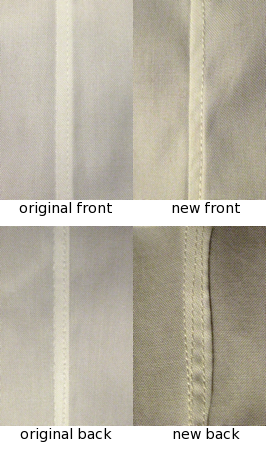
Having recently heard the above Grandma story and faced with the need for a white dress shirt, I decided to try to take in N's Costco shirt.  It was the most complicated alteration I've ever done and it didn't go over too badly. (Most of my past stuff has just been hemming which is pretty much straight lines.)

Here are the gory details via photo documentation, including a very messy interior/back (what do you call the side that goes towards the body?). And don't tell me it's not messy, 'cause I cherrypicked the nicest part...you don't wanna see the bad parts and you're never gunna have to, so there.  It fits him nicely, which is the important part.

20110705

biking in skirts

Now that summer's heat is in full force, I enjoy wearing skirts pretty much every day.  The only problem is in biking to work: my bike has no guards on the wheels or gears.  The last time I tried biking in a skirt, the skirt got caught in the back wheel and was reduced to scrap material.

I didn't want to change my bike at all and barring that, most of the online solutions for biking in skirts deal with skirts that just make it over the knee.  Unfortunately, most of my skirts are pretty solidly mid-calf and below, which is to say I'm worried about the skirt getting caught and not about modesty.

I've biked in aladdin pants that tuck in below the knee, and those worked fine, so I decided to try a method where I temporarily tie the skirt together between my knees with a hairband.  I gave it a first shot today with a skirt that came a few inches above the ankle and it worked really well: my knees were covered and nothing got caught.  Nobody gave me funny looks, even.  I'll have to try a few more lengths, but this might be my solution.

20110629

new place

N and I just finished up the first day of moving to a new apartment in the same complex, over the course of which I developed an intimate relationship with shopping cart that had a funky blue front wheel which spun around spasmodically.  Luckily we're able to move over a 47 hour period, so while today was exhausting, this is one of the least stressful moves I've experienced.  And maybe I'll be able to spend more quality time with Ol' Funky Blue tomorrow.

Since we have so much time, we're doing this move a little differently than I've done in the past.  Previously, I've packed up non-essential things ahead of time; now, we've moved in all the things we need immediately--the kitchen, bathroom and bedroom.  Craft supplies, some books, backpacking/camping gear,  decor, etc. get left behind for now, and I'm really digging this system.  We're forced to re-assess if we need certain things, especially since we're moving to a smaller space.

Our new place isn't perfect: the kitchen has no pantry (something will need to be done about that) and we didn't escape having a disability-friendly bathroom like our last apartment (It's considerate of the University, but really ugly and impractical for those that don't need it.  At least this time we have a tub.). Two more gripes are the cinder-block walls (can't hang anything, not aesthetically pleasing), and the stove is electric (which is just a matter of preference and my smallest gripe.  At least I have a stove, right?).

The things I like about the apartment far outweigh the disadvantages.  For starters, the kitchen has a better layout on average--it's wider and more open to the living area.  Since I spend a lot of time in the kitchen, it's nice to be able to talk easily with someone in the living space, especially when there are guests over.  I've already said that it's smaller, but it's definitely more suited to our needs.  There might be some shrinking pains, but it'll be better overall.  There's a bathtub, which theoretically provides an occasional luxury, but is also useful for hand-washing clothes and letting things soak; it's also easier to clean than a straight shower, in my opinion.  Alright, that's enough blather.  Quick list of more pluses of the new place: bigger fridge, AC, views of the woods, and better overall layout.  Also, no bus stop outside the door.  BAM.

Life is breezy.  I'll post photos when things settle down a bit.

20110627

Brave Trailer

I've been anxiously anticipating Pixar's Brave since I saw the concept art forever ago.  The first trailer is out at disney.com/brave!  I love that Merida looks like she's not wearing any makeup (contrasted with Rapunzel in Disney's Tangled who has blonde hair and black eyelashes); they make it obvious that the story is not about her looks or her love life, which is really refreshing.  The clip is too short to make any final judgements, but thus far it looks like a story about a strong character who just happens to be a girl.  I'm stoked.

20110626

there are always more firsts to be had

This weekend was the first time my in-laws visited us--as opposed to us visiting them in Denver, which has happened twice.  I like both of them, we interact well, and they aren't particularly judgmental or nagging or any of the old-school negative in-law stereotypes.  Despite this, I still felt the compulsion to have everything perfect and spent the day of their arrival cleaning and prepping; when I get obsessive over guests (or anything) like this N calls me by my maiden name because it's inherited/learned from my father (Love you, Dad!).

Anyway, I cleaned a bunch and made a nice dessert (which unfortunately I didn't photograph, so I'll just have to make something similar but even nicer for a certain wedding dessert-potluck this summer!) and tried out an experiment inspired by the latest Bon Appetit magazine.  [Imagine the structure of cinnamon rolls but with a savory spinach, shallot, and goat cheese filling.  (BA had a cilantro/scallion filling topped with sesame seeds)  I didn't like the dough that much, so I'll try a second round before posting a recipe.]  I even bought a bundle of lavender for use as a bouquet. (I'm drying the flowers now to make sachets).

Double anyway, the visit went well and now I'm exhausted.  Time for a nap.

Also wik: we saw Memphis on Broadway with them on Saturday, which was amazing!

20110619

Mars, Venus, and gender identities

The topic of gender has been floating around my conversations more over the past few days than usual--and it's usually pretty high up there anyway.  The two main events contributing to this were the sexing of a fetus-in-law (and discussion of if a quilt-in-production would be a well-received gift) and an explanation to my brother of why Live it Up! by Mark E. Petersen is hilarious and mildly offensive, complete with an introduction to the idea of gender as a social construct.

I could rant and rave about the gender in the Mormon context, but so many people have already done so very articulately that I would most likely be regurgitating their ideas, even if that wasn't the intent.  Instead, I want to explore the Mars and Venus...as in, the Roman gods.

Mars and Venus are only one of the six god-goddess pairs in Roman mythology.  Why did they become our modern gender archetypes?  For one thing, each have a planet in their name (and Venus is the only female name among the planets), so it's simply a matter of history, for better or worse.  However, if the planet Venus had been called Minerva (equivalent to the Greek Athena), would that have changed much?  Would we just have ignored the planets and come up with something else?

Anyway, the Roman pairing are as follows, with their Greek equivalents and a rough description of their jurisdictions, mingling the mythologies together.

Jupiter (Zeus: king of gods, sky, thunder) and Juno (Hera: women, marriage)
Neptune (Poseidon: water, sea, earthquakes) and Minerva (Athena: wisdom, civilization, warfare, crafts, justice, poetry, etc.)
Mars (Ares: war and agriculture) and Venus (Aphrodite: love, beauty, fertility, sexuality)
Apollo (light, sun, truth and prophecy, medicine, healing, arts, etc.) and Diana (Artemis: hunt, moon, wilderness, childbirth)
Vulcan (Hephaestus: fire, volcanoes) and Vesta (Hestia: hearth, home, family)
Mercury (Hermes: messenger of the gods, trade, guide to the underworld) and Ceres (Demeter: agriculture, fertility of the earth, seasons, and motherly relationships)

There are so many more complex male-female relationships and distinctions listed in these pairings than the simple and prolific Mars-Venus analogy.  Archetypes and mythology are both intriguing in that they reveal aspects of the nature of the world, perpetuate ideas, and demand inspection of their subjects.

I just don't identify with Venus or many of the traits modernly associated with women.  There are many things I do like that are "womanly": skirts, cooking, sewing; but just as many things that are "manly": computers, cars, backpacking.  I hate being conscripted.  I've said it many-a-time and will continue to do so until the day I die: men and women are more the same than they are different and I wish we (encompassing many levels) would stop focusing so strongly on the differences.  But individuals love being different and cling to archetypes like Mars and Venus to emphasize their distinctiveness.  Just WHY VENUS?  I would take any of the others...Athena, Hestia, Demeter, Artemis (I'm obviously more familiar with Greek Mythology), even Hera.  If only one of them had a planet named after them, I'd have a catchy retort when people say things like "men are from Mars, women are from Venus"--which I have heard/seen used in earnest, mind you, which was actually one prompting for this post--I'd be able to say, "Actually no, I'm from Minerva, thank you."

20110616

being human

This past week, N felt like starting to watch a TV series that was sci-fi-y. "Star Trek TNG?," I suggested, which hit the spot. At this point, we've watched the first seven episodes of the first season sequentially--a new experience for both of us. Both our parents were Star Trek fans, but watching them in order never was particularly important; except for the occasional two-episode plot, each one was pretty stand-alone. In what little I've see over this watching, I can pick out elements of character evolution, but nothing that demands a sequential understanding or that pulls a viewer into the need to watch more immediately. While I tend to like shows that have a larger story arch pulling it along (which TNG still has, but it's very, very mild), I'm glad I'm not feeling the compulsion to watch all 178 episodes in rapid succession.

One thing that is a large concept explored in the show is humanity; this theme is much more pronounced that I remembered, my memory being limited to Data's desire to be human. In particular, the attitude of the humans in TNG seems to be very apologetic about the past; they cling to the idea that they have evolved/changed to be a better species. In the pilot, for example, Q tests the the crew of the Enterprise.
PICARD: What? That nonsense is centuries behind us.
Q: But you can't deny that you're still a dangerous, savage child race.
PICARD: Most certainly I deny it. I agree we still were when humans wore costumes like that, four hundred years ago.
Q: At which time you slaughtered millions in silly arguments about how to divide the resources of your little world. And four hundred years before that you were murdering each other in quarrels over tribal god-images. Since there are no indications that humans will ever change.
PICARD: But even when we wore costumes like that we'd already started to make rapid progress.
Then, later:
PICARD: Alright! We agree there is evidence to support the court's contention that humans have been savage. Therefore I say test us. Test whether this is presently true of humans.
Still later...
RIKER: Have you understood any part of what he's tried to tell you? Humanity is no longer a savage race.
But it's not just the first episode.
PULASKI: I'm just glad that humans have progressed beyond the need for barbaric displays. (2.14)

DATA: Judging a being by its physical appearance is the last major human prejudice, Wesley. (2.19)

RIKER: Maybe if we felt any human loss as keenly as we feel one of those close to us, human history would be far less bloody. (3.5)
Data and Q both exist, in part, to tease out the essence of humanity over the course of the show.  Humans are good and they keep getting better is the message we are sent.

Then there's Firefly, where human nature stays more or less the same through time.  This is implicit in the world, but it is also made explicit in Serenity, where improving humanity artificially is villainized and the messiness of humanity and human life is almost glorified.
The Operative: I'm sorry. If your quarry goes to ground, leave no ground to go to. You should have taken my offer. Or did you think none of this was your fault?
Capt. Malcolm Reynolds: I don't murder children.
The Operative: I do. If I have to.
Capt. Malcolm Reynolds: Why? Do you even know why they sent you?
The Operative: It's not my place to ask. I believe in something greater than myself. A better world. A world without sin.
Capt. Malcolm Reynolds: So me and mine gotta lay down and die... so you can live in your better world?
The Operative: I'm not going to live there. There's no place for me there... any more than there is for you. Malcolm... I'm a monster. What I do is evil. I have no illusions about it, but it must be done.
...and then later, referring the discovery of Miranda and how the Alliance both killed people and created monsters while trying to make people better by adding drugs to the air:
Capt. Malcolm Reynolds: This record here's about twelve years old. Parliament buried it and it stayed buried until River here dug it up. This is what they were afraid she knew. And they were right to fear. There's a universe of folk who're gonna know it, too. Someone has to speak for these people.
[pause]
Capt. Malcolm Reynolds: Y'all got on this boat for different reasons, but y'all come to the same place. So now I'm asking more of you than I have before. Maybe all. Sure as I know anything, I know this - they will try again. Maybe on another world, maybe on this very ground swept clean. A year from now, ten? They'll swing back to the belief that they can make people... better. And I do not hold to that. So no more runnin'. I aim to misbehave.
So does humanity evolve?  Social expectations surely do, but those are localized.  Even if they were universal, would our changes be for the better?  How could we even know if we are part of society?  Technology and access to knowledge surely evolves.  Can knowledge and understanding change a person, or are people static machines that change their actions according to their respective situations?  I tend to divide our individual influences into genes and memes, but is that the right model?