GEEKERY  
ADVENTURE  
CONTEMPLATION  

20141030

October books

A genetically engineered apocalypse, a half dragon half human child, and necromancy. Perfect Halloween reading.

Oryx and Crake ★★★
This book left me reeling.  There were eerie similarities to the world surrounding me, one of which was the decaying nature of autumn, but I think the most compelling aspect of this book was the uncertainty.  On the one hand, we have god-like orchestration of plants and animals through genetic engineering, but the human motivations are left ambiguous.  The contrast between scientific precision and human enigmaty [1] was the major contributor to my stupor, but another culprit was the discouraging resemblance between the fictional society and our contemporary one, which raised apprehension about our own future.

Seraphina ★★
A curious YA novel about a dragon-human hybrid girl who has a strange way of walking around inside her own head.  While plot elements like murder, deception, and love abound, the core of this book addresses two main topics: prejudice and the balance between emotion and reason.  These subjects are addressed in the context of fantasy, however, and it is left to the reader to interpret them (or not) to apply to reality.

Clariel ★★
This YA book just came out on October 14.  I identified with Clariel immediately; she was a wilderness girl recently brought to a big city for her mother's work, and complained about the lack of trees.  I love the wilderness but commute weekly into New York, and have been known to complain extensively about the condition of trees in various cities.  Reading her complaints was like reading a transcript of my own diatribes.  And then her incessant whining got tedious.  And then she was stupid.  It is an interesting addition to the Abhorsen series, but probably my least favorite—I'll read the original three over again on occasion, but once is enough for this one.  It was also hard to tell when this happened relative to the other books—the resolution of this question was interesting, but I wish it was in the content of the novel itself instead of the author's note at the very end.

Next up: the newly released The Slow Regard of Silent Things.

[1] Yes, I did "make this up," but it's a word that should really exist.  The only word that means the quality of being enigmatic according to the OED is the obscure enigmaticalness from 1684, which was probably "made up" then as well.  Enigmaticness could also work, and is parallel to words like frantic and franticness, or enigmaticity could do, but I like brevity and enigmaty was the first thing that came to mind.

20141007

meaningful service

Within my church community, we frequently emphasize service as a good thing that we should seek perform for others.  As such, we often organize service activities, in which we come together as a community to perform larger scale service that we might not otherwise be able to do as individuals. While I think this is a great idea, I think that there's one major aspect that can often be improved.  More on that soon.

There are roughly four objectives in performing service:
  • Help  This is the most important objective: to fill the needs of others.  Needs can range from the physical, like hunger, to social needs, like loneliness.
  • Feed the Fire  Individuals need to feel compassion for others; part of the goal of service is to kindle that desire in individuals so that they will be better people in their daily lives.
  • Community building  Whether individuals are working side by side in an activity or one person is helping another, service forges connections within a community.
  • Be an example  Here, the goal is to inspire people outside our community, either by welcoming them to join us or reminding them to do good independently.

The last objective is difficult in many contexts because it often gets conflated with getting good press, which is not the goal.  If we want to take pictures for our own memories, that's fine, but taking picture for the explicit purpose of handing them to a reporter seems disingenuous.  When we're trying to be an example, we should always be inclusive, which is to say, we should never isolate the people we are talking to. We should try to make them feel like they were there with us so that next time maybe they will be.

What I really want to talk about is the first objective: actually helping people.  We have a responsibility to be effective in our choices of service.  We need to ask ourselves: what are real needs? and not what is easy to do in the hour we have on Wednesday night with the youth?  Certainly we aren't always ready to ask these questions—there are weeks when easy is all I can handle.  When we have extra time and energy, however, this is where we should put the effort.

What are common service projects?
  • tie the ends of felt quilts
  • local disaster relief (e.g. hurricane cleanup)
  • writing letters to missionaries
  • yard work / housecleaning for members
  • visiting with seniors or disabled individuals
  • baking things for people
  • making sanitation or relief kits

Take an honest look at the list.  Which of these have you done?  What has been your mindset for each one?  What mindset has the activity encouraged?  The winners for impact are local disaster relief and visiting with seniors or disabled individuals; not coincidentally, they almost always are accompanied with a sincere charitable mindset.  Other tasks are more about the secondary objectives.  When writing generic one-time letters to missionaries that you don't really know, who is really benefiting?  What about tying the ends of piece of felt that's just as effective as a blanket without your effort? Often it's more about performing the service than the actual impact of the service itself.

What else can we do that's effective?
  • We can  develop long lasting relationships with lonely or outlier individuals. These are not just one-time visits.  My brother used to go play chess with a retired man in our neighborhood; I don't think either of them even thought of it as service, but it brought effortless joy to both sides.  This could be a simple as going to watch a fun TV show with someone.
  • Fundraising  I think we shrink away from fundraising too much; there are a lot of fun, creative ways to fundraise, especially if we reach outside the church community.  Dessert auctions, hunger banquets, craft bazaars, yard sales, by-donation dancing lessons—the possibilities are endless.  If the proceeds go to an effective charity, this seems like a great option.
  • Tutoring or reading to underprivileged kids.  I was a reading buddy at an old workplace which was walking distance from an elementary school with lots of low-income ESL students. A group of us would go over and read to the kids and play word games like hangman.  It was fun, easy, and effective.  Some kids just aren't getting enough individual attention to learn as best they can, and you can help.

What's the take home message?  We need to think about the people we're trying to serve first: what are real needs that exist in the world?  Maybe we need to do more research, or maybe we just need to think outside of our usual sphere of influence.  Regardless, we need to stop worrying as much about the secondary objectives.  You should know that something is wrong when you have the idea for a service project and then ask: so who could we give this quilt to?  All of the objectives I've listed are good; it's just a question of good vs. better.  

20141005

hanging the unhangable

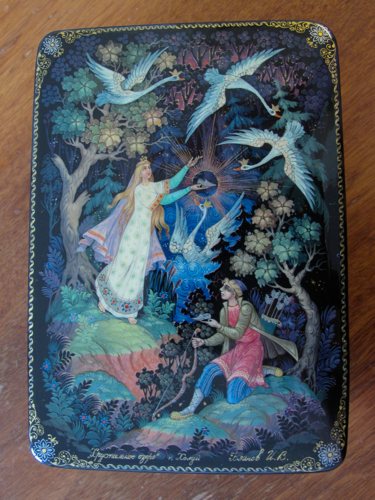
I have a collection of Russian lacquer boxes that depict fairy tales (in the Kholuy style, for those that care).  I originally saw these in a hotel while traveling in my family state-side.  For whatever reason, I became obsessed.  I love miniatures, boxes, and art generally, so I suppose it's not terribly surprising.  I found a the Tradestone Gallery sometime in college and honed my bartering skills as I purchases boxes over time. I've since become less fixated on acquiring boxes, but I still love the ones that I have.

For the past four years, however, they've remained in boxes because there hasn't been a good way to display them; we don't have much in the way of surface space.  I've considered various was of hanging them on the wall, but it is a difficult task to do so while not harming the boxes.  I've mused about using strong magnets to photo ledges, but nothing seemed to be both economically reasonable and aesthetically pleasing.

Finally, I stumbled upon tool hooks, which are cheap, stable, and don't get too much in the way of the boxes. This weekend, I picked up one for each box and mounted them on the wall.  NWC is worried about them rotating, and so I'm thinking of gluing them in place where they intersect the wall.

Aside from one wrong hole (the screw wouldn't go in), I think it went very well. 


20140927

onion maggots

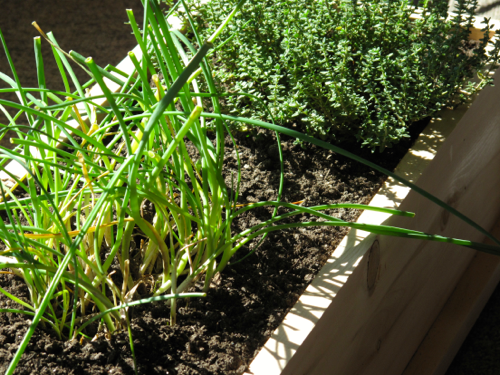
I recently brought in my herbs from the garden and planted them in a cedar planter box under our living room window.  My rosemary was too dead to bring in, but my thyme and chives are doing alright after a week or so, or so I thought until today.

I was grooming my chives by pulling away dead leaves when I accidentally brought up a bunch of live ones.  After doing so, I noticed that the base looked a little bit like the green onions you buy at the store with stubby white roots, and thought Huh. I didn't know that.  And then the roots started moving.  For a moment I thought I was hallucinating, but quickly realized that there was something living in my chives and it looked like maggots.

After inspecting and disposing of the chive saboteurs that I had uprooted, I went to the internet to identify them as onion maggots.  My current approach is going to be keeping the chives warm and dry, but I'm curious to hear if other people have more direct remedies for this pest.

Worst case, my chives die off and I start new ones; they're easy to grow, so I won't be heartbroken.  If something like this happened to my beautiful little thyme plant, however, I would be very agitated.

20140924

In favor of "BigLaw"

Last Friday, my amazing little brother published an article in the Harvard Law Record entitled Want to Save the World? Do BigLaw! which has had mixed reception, including a rebuttal that was published in conjunction with it.

My brother has an intentionally inflammatory style for humor (see also: our childhood), but his point was this: if you can withstand the indulgent aspects of corporate culture, then you can do more good by making lots of money and donating it to effective charities than you can by donating your career to particular causes.

While I think that there always individual exceptions, I agree with his analysis.  The market has greater capacity for corporate lawyers than for public interest or government positions.  Additionally, the scope of influence for the latter two is usually limited to the nation in which the individual practices.  In the case of American public interest lawyers, the people benefiting from their services are usually American citizens or residents (legal or otherwise).

In all countries there are marginalized populations; these people deserve advocacy and legal protection.  However, if citizens of a nation wait until all of their fellow residents are happy and healthy before they look outside their own country to do good, then they will likely be waiting indefinitely.

The US is incredibly privileged.  We still have problems, but citizens of many, many other countries have it much, much worse off than even the poorest among us here.  We can choose to pay $3 for someone's lunch in America, or spend that same money on a Malaria net that saves a child's life [1].  It simply comes down to the most effective allotment of resources.  (And requires thinking globally instead of nationally.)

In the case of law, I think the numbers work out in favor of practicing corporate law and donating a percentage of your income.  Everyone must make their own choices, but I think if more people took this path, it wouldn't only be good for the recipients: lawyers practicing this lifestyle might begin to change corporate society, steering it away from consumerism and self-indulgence.


Press for his original article:
Above the Law: What Harvard Law Students Tell Themselves When The Demon Come

[1] Probabilistically, it actually takes more than that to save a life, since not everyone is guaranteed to get malaria; the AMF puts the figure at about $2,500/life.  In the US, that could be used for a fancy computer or a vacation.  It's also less than four month's net income for the average US food stamp recipient household.  The average food stamp recipient is gets $133.85/month, or less than $1.50/person/meal.  So the real comparison is helping to feed a family of four (in the US) for a little over a year vs. saving a life.  It's not so cut and dry, but I think the life still wins.

20140916

white keyboards (little moment of compulsion #7)

I have one of them fancy-pantsy mac keyboards at my office, and it bothers me beyond belief when the pristine white keys start to build up a border of brown.  When this happens on my keyboard, I generally just clean the one key that's particularly problematic, but today I broke down and meticulously worked over each key and the metal in between.

I took out the batteries so that I wouldn't end up with a terminal full of nonsense, but I'm still finding spots that need a bit more work like nhghjhgf that one.  It makes me shudder to think about the cleanliness of non-white keyboard keys, like the ones on my laptop.

professional face

I just redid my academic website, and I'm proud of the changes.  I stole design elements from Jaan, who used a modified Jekyll theme.  Before/after screenshots below, with old on the left and new on the right.  The CS web servers are going through a transition to a more secure system, so the changes won't be live for a bit.  I've debated getting a url for my academic webpage, or integrating it somehow with this blog, but I'm still not certain about what I want to do; it's nice to keep my personal rants and hijinks away from my professional front.


20140911

9/11 in NY

Today I was up in New York on regular business—reading group and my lab's group meeting.  When I arrived at Columbia, the main walk was covered in hundreds if not thousands of small American flags, and I remembered the date.  Throughout the day, it got lots of attention: people took pictures and there was even a pro-Palestine rally of some kind.

I was safely in California thirteen years ago, but I still remember waking up to the news and sitting on my parent's bed watching the smoke.  When a peer said that there was another attack at the Pentagon, I thought he was just trying to get attention.  So I was a little solemn today, as it made things a little more real, knowing that some percentage of the people around me had lived through the event in the city.

But then I witnessed something bizarre during the afternoon: a young woman plucking a handful of flags and then tossing them in the garbage with apparent distain.  I didn't know what to make of it.  Was she anti-American?  Was she an American citizen?  Was her family or her home country harmed by the US?  Was she somehow against the display of flags?  Did she lose family in 9/11 and was frustrated by the reminder?  It remains a mystery.