GEEKERY  
ADVENTURE  
CONTEMPLATION  

20140906

Sourland Spectacular

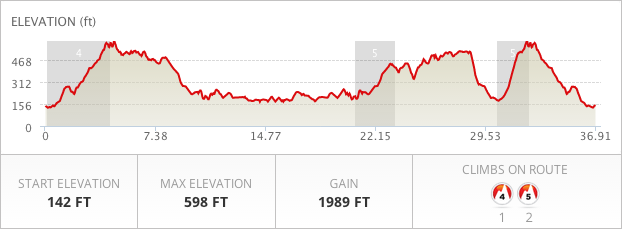
This morning NWC and I participated in the Sourland Spectacular road biking event, doing the 36 mile route.  It's the best biking in the area, and there are also a lot of small farms nearby, so several rest stops featured delicious local produce.  It was the longest bike route I've done, and the first athletic event I've ever done as an adult, though I wouldn't call it a race.

To make things more challenging, my front derailleur (part that shifts the gears) is broken, which meant I could only shift within the middle three gears.  It kept me from going to fast on the flats and downhills, but there were a couple uphills that were brutal because of it.


I finished in about 3 hours 45 minutes, including all four rest stops.  It wasn't great timing, but it wasn't embarrassing either.

People were very nice and encouraging, although one lady was a little unintentionally condescending in her encouragement.  Overall, it was very enjoyable and I wouldn't mind getting in shape for a proper race.

20140716

not allergic to bees

While running this morning, I noticed that the wild raspberries were out, and I took a break to pick a few.  While rummaging in the bushes, I received my very first bee sting. When it happened, I felt pain in the skin over my achilles tendon, and looked down to see a striped insect flying toward my face.  I flailed like a child and took off running, four raspberries cradled in one hand.  After getting some distance behind me, I inspected my heel and removed the stinger and remnants of bee abdomen.

I received two wasp bites as a child, and was always afraid of being allergic to bee stings.  It hurt much more than I had anticipated, but the pain had mostly subsided by the time I returned home.  I was a little anxious, and N commented that for someone who likes bugs, I wasn't doing very well.  But once it seemed clear that I was having no allergic reaction, I became a bit giddy: I was never really afraid of being stung, but the potential allergic reaction.  Liberated from that fear, I may now begin a career in beekeeping.

20130724

taking up tennis

This beautiful photo is Copyright Arvin Rahimzadeh.
Several weeks ago, N came up with the brilliant scheme to have of play tennis regularly.  We went out and bought the cheapest rackets we could, as well as two cans of balls, and started the same afternoon.

In my obsession with planning, I decided we would go every Monday and Friday thereafter, to which the gods decided they would make it rain every Monday and Friday.  We've therefore been playing sporadically, and often on wet courts, if not in the rain.

I'm terrible at tennis, and when I started, I'd guess about 10% of my serves were legal.  This meant I was (and still am) thoroughly trounced any time we played a set.  Two weeks ago, I decided that I would have to complete 50 successful serves before we could play a game.  Fate being what it is, of course, the first time I tried my 50-serve goal, a thunderstorm commenced after I spent a half hour reaching 15 legal serves.  We waited it out, finished my goal with soaked tennis balls, and played two games before going home.  N had to serve both since my arm was sore.  Incidentally, he also won both.

In addition to giving my arm a harder workout, the wet tennis balls forced me to serve overhand, since bouncing them for an underhand serve was rather difficult.  Although everyone seems to be recommending me to do underhand serves to start, I find overhand to be more intuitive, and it's obviously more powerful too.  The only problem is that now that I want to hit everything overhand, which doesn't get as many balls over the net.  One step at a time, I guess.

Since then, I've gotten much better at serving.  I'm good enough now that it's boring for N for me to do my warm up--before he had to both be encouraging (so I would keep going) and run around a lot more when my aim was worse.  As a result, I've reduced it to 25 legal serves before we can play.

Tennis is definitely less of a workout than running or biking, but the game aspect gets me to do it more frequently, so it's hard to say which is better long-term.  I don't like that one arm gets more of a workout that the other, but I'm ambidextrous enough that once I get decent with my right arm, I might play with my left arm occasionally to balance things out.

All-in-all: it's lots of fun, but I've got a long way to go.  Any tips, pointers, or suggestions are welcome.

20120403

dear diary

It's been nose to the grindstone here, or nose in the books, or however you want to say it.  Work.  Noses.  It's all the same.  So here's an update on a bunch of miscellaneous things.

I've been reading Go Ask Alice and Cloud Altas, both of which are excellent.  And I'm still going to the gym, for the most part.  I've taken a few sporadic days off recently due to the aforementioned nose issue, but I don't plan on stopping any time soon--it feels great.  I keep looking at my arms and being amazed that I can actually see a hint of muscle.

My seedlings are growing leggy for lack of light.  N did all sorts of research on it yesterday (including some Matlab computation) to figure out if we needed to buy different lights for them.  He decided we did, so we went out today for that.  I'm thinning them out and replanting them in the same containers, just deeper, so they stop falling over (cabbage, I'm looking at you).

What else?  I was released from my calling at church just to be re-called to the same thing--one of those leadership shuffles.  Kinda wigged me out, I must say, since they emailed me in the middle of the week to schedule a meeting for Sunday.  I haven't had a formal meeting time set for a calling since I can remember, so I kept wondering if I was in trouble for something (a.k.a. corrupting the young'uns with my blasphemous ways), or if they wanted me to do something crazy.  N kept saying they were going to call me as prophet.  But no, it was nothing special.

Funny thing though: I was teaching a lesson to the young'uns the day I was recalled...and I was talking about the good things prophets tell us to do (e.g., praying), the bad things they tell us to avoid (e.g., gossiping), and grey-area things where they give us some council but don't straight-up tell us what to do (e.g., who to make friends with).  When I asked for examples of bad things to avoid, one of the teachers came out and said that Hinckley warned us not to attend raves.  In response, I told her that I used to go to raves.  It cracked me up to hear all the kids gasp.  Regretting that re-calling now, eh?

But, it was a good segway into the grey-area bit, saying that parties are something that we need to be careful about, blah blah blah.  With Go Ask Alice on my mind, I warned them against drugs.  One kid pretended to offer drugs to another, and I got to tell them that people actually do that.  It's real.  I've been offered drugs at parties by complete strangers, I told them (and it's true).   Drugs aren't a joke.  They make people to crazy things.  Betcha nobody was expecting to have that conversation.  Good times.

Another thing that's been on my mind of late is the line between constructive criticism and destructive criticism.  In particular, I've been thinking of how it relates to improving a religious organization like the LDS church, wherein the whole purpose of said organization is supposedly to bring constructive change to people's lives.  On some level, I criticize an organization or its members for my own sake, usually to justify my feelings on various points.  On the other hand, if I feel negatively about some aspects of the organization, do I have an obligation to help change it?  How about if the struggle for change is personally painful?  How about if that struggle brings unwanted personal change?

Lots of random thoughts.

20120207

how isolated are you?

There's a quiz based on the recent discussion of the cultural isolation of the elite: "On a scale from 0 to 20 points, 20 signifies full engagement with mainstream American culture and 0 signifies deep cultural isolation within the new upper class bubble."  I score a 6, which isn't terribly unexpected, but it makes me kind of sad.

It also makes me wonder about what defines "mainstream American culture."  Hunting and fishing?  Seeing Transformers?  Stocking your fridge with mass market beer?  Buying trucks?  This is mainstream American culture?  Really?  I feel like all of those things breathe privilege on some level, like you have the money (and time and energy) to go hunting, see Transformers, stock your fridge, and buy a truck.

Then again, it's an online quiz...I don't know what I was expecting.

Update: I also like that this whole discussion of "mainstream American culture" is exclusively about non-hispanic white people, who make up like, what, 64% of American society?  It makes sense in that white folks have been the majority of the American population for a while and so we can talk about the changes, but it also seems like we're talking about the wrong thing.  American society is no longer as homogenous as it used to be, and that change means that we need move away from the idea that our culture is homogenous.  Remember: salad bowl, not melting pot.  That doesn't mean I think that the elite should be isolated, but it does mean that everyone (especially the elite), needs to be aware of the other facets of American culture, which means going beyond trucks and Transformers.

20120201

noodle

I just got back from a trip up to Boston, which was excellent.  N left for Niger last Saturday, and not wanting to be a lone woman in the garden of Eden, I took to the north.  All I can say is that my friends and family are wonderful.

After a long drive home, my todo list for the evening was: 1) unpack 2) go grocery shopping, 3) work out at the gym, and 4) do some work-type stuff (prepping for an HCI event tomorrow).

Number one has resulted in an explosion all over the living room.  Number two involved dropping a 1 gallon glass bottle of apple juice in the apartment parking lot (I sense a pattern...).  Number four I might put off until the morning.

Number three, though.  Man, oh man.  I'm not really a gym person.  I've tried various things, but none of them have stuck thus far.  The machines scare me.  But!  My cousin-in-law Rachael is totally amazing and got me to get over my phobia and try getting serious about working out at the gym.  We're trading personal training for coding lessons, and it's awesome.

Tonight was my first night trying the workout she's given me, and whooaoao. I have a long way to go.  My legs seem strong enough, what with all the walking and hiking I do, but everything else?  I feel like a total noodle.  For some of the machines I was like, "What do you mean you don't go any lighter than that?"  And the machine responded, "Suck it up."  Noodle.  I haven't felt this kind of adrenaline for a long time, and I'm stoked.  And laughing at myself, but still stoked.

20111213

paper and pixels

My gut reaction to new devices is "don't need it."[1]  E-readers, smartphones, tablets, whatever.  Don't need it.  My seminar on the future of the book has changed that a little.  I can now see the place for digital books, and would actually love to have a good color e-ink (not LCD) reader for pdfs and one-time reads.  The system isn't set up to work the way I want to use it, though.  Supposedly you can use your public library to gain access to ebooks, but even our huge library doesn't have access to the digital versions of anything on my reading list.  I'm not paying anything for something I'll read once, even if it's cheaper because it's digital.  And Amazon is still missing a lot of stuff.  So no e-reader for me for now.  The for now is the concession I've made.

One thing that came up in class was the advantages and disadvantages of each form.  I got in a match with my professor, each of us claiming that we could list five things off the top of our heads why one form was better than another (he's a digital advocate, I'm dedicated to bound).  We didn't actually list five each, but I wanted to make those lists for comparison, so here they are.  The advantages of bound books will only decrease with time, but these my current top five.

Advantages of Digital Books
- easily searchable
- more ergonomic to use (due to a lightweight and balanced form)
- conducive to a minimalist lifestyle (fewer physical things to manage)
- easier to travel with (smaller/lighter)
- instant access to one's entire personal collection and also to purchasable content

Advantages of Bound Books
- superior random access [2]
- cheaper (due to libraries/borrowing/sharing and buying used) [3]
- easier to consume from multiple vendors
- more accessible interface (no manual, forums, or help needed)
- apocalypse-proof (or able to withstand long-term power-loss/reduction)

I have no idea what is more stainable.  On the one hand, bound books mean paper, which means harvesting trees.  On the other, we have rare metals (and thus probably fair-trade issues), but also electricity consumption.

I don't think I'll ever go all-digital, but who knows.  Even art books might be addressable eventually.  The biggest hurdle will be converting my preexisting collection of bound books into digital books.  And sharing.  I need to be able to share my books without having folks borrow my entire library (i.e. the device).

It basically comes down to cost.  I'm not willing to re-buy everything I have nor am I willing to pay 10 to 20x more for a slight increase in convenience.  I could deal with everything else if I could get any book for $0.50, which is the standard cost of paperbacks at library used-book sales.  Heck, I'd be willing to pay the hardback $1.  But as long as the alternative to borrowing a book from the library is to pay an insane amount, I'll stick with my bound books.  They need to market books on the app cost scale for real viability; most books should be under a couple of dollars.

[1] Right now, anyway.  I used to be a huge gadget person--I had a PDA in middle school, even though that's obviously not something a middle-schooler needs.  Shall we schedule hanging out in the quad for 3:10pm?

[2] With digital books, there's no good way to hold a finger in one place and flip to another, nor is there a good mechanism for flipping through the book to find non-text.

[3] One thing that weighs on me is that a shift to digital books makes reading more privileged, at least as currently implemented.  Sure, free ebooks are great, but most of the free ones are epub, which Kindle doesn't support.  So do you forgo Amazon's selection and go for a Nook?  How about an iPad with apps to do everything for $500?  Laptops are cheaper.  I'm pitching my Occupy eBooklandia tent.

20111115

we are the 100%

Honestly, I'm a bit tired of the "we are the 99%" and/or "occupy ____."

I think that there are a lot of good ideas and moving stories, but the lack of organization just kind of irks me.  I'm not going to take a stand with someone, friend or stranger, unless I have a compelling reason.  And a group of people?  I'm not going to join a mass of folk without it declaring a clear set of goals or ideals.  Maybe I'm a persnickety list-maker, but I just don't get it.  It feels like herd mentality.

My life is pretty good right now; I might be singing a different tune if I were hugely in debt, grappling with medical issues or otherwise had life in disarray.  Despite life's goodness, I like to think that I'm a survivor by nature, doing what I need to do, even if life is hard.  [Tangent: Hunger Games is next on the reading list.]  And if I'm not a survivor, I'm at least an optimist, focusing on the good things.  Everyone has a breaking point though, and to me the 99%/occupy movement seems to be declaring that most people are close to breaking, if not already there.  Part of me is skeptical, thinking that folks might be exaggerating, but part of me knows that I'm really lucky and that there are lots of folk out there dealing with a lot of unpleasant stuff.

So, in the spirit of sharing 99%-style, here's some info about my life. As a household, my husband and I are above the 50% mark of Americans [2] by income.  We're both in graduate school and attend the same name-recognized school.  We're in the youngest 20% of Americans, including the lowest 10% being children/adolescents ages 14 and under [3].  It seems ridiculous to me that we're over the 50% income mark given that we're both at the start of our careers and still in school.  We have retirement and savings accounts, and are able to donate money as we see fit.  Our health coverage isn't great, but since we're healthy, it doesn't matter much for now.  I am worried about health coverage for the possibility of having kids at some point; I'd like the birth process and pediatric stuff to be well covered.

My problems are very, well, insignificant next to issues of starvation or vaccination.  There's still pretty small next to eviction or massive debt.  I feel like I have 1%'er problems, even though I'm in the 99%.  I feel like a lot of people in the 99% have this same magnitude of problems, and that income is not a good metric for separating the privileged from the struggling.  I think that's part of why the whole thing irks me: it's including me when I shouldn't be included.

[1] per this article by the WSJ
[2] internationally, it's a whole 'nother ballgame
[3] I did this with rough approximation, given the percentages listed here.

20110218

The Privilege of Rights

This is the final installment of a series of three mini-essays on privilege. The first two are here and here.

As western society has evolved, it has declared a certain set of freedoms and entitlements to be called rights. The United States' Declaration of Independence proclaimed, "We hold these truths to be self-evident, that all men are created equal, that they are endowed by their Creator with certain unalienable Rights, that among these are Life, Liberty and the pursuit of Happiness."

As the US government evolved, the Bill of Rights was written, setting out a number of familiar rights: freedoms of speech and assembly, the right ro bear arms, etc..  Further amendments to the constitution have been added since, many of which included some concept of rights.  Other western countries have similar concepts reflected in their relative governments: there is the British Bill of Rights of 1689, the German Grundgesetz of 1949, and Title 2 of the Swiss Federal Constitution, among others.  Furthermore, the United Nations' International Bill of Human Rights was passed 1948.

When it comes to rights, there is a lot of disagreement.  Contemporarily, the LGBTQ community is fighting for the right of same-sex couples to marry in the US, though they are free to so in other countries.  China is known for limiting some freedoms we take for granted in the States.  Several international human rights organizations condemn North Korea for being brutal to its people.  Philosophically, there is a distinction between legal and natural rights, the latter being along the lines of the "unalienable rights" mentioned in the Declaration of Independence.  The problem is, like in all things philosophical, there are differing opinions of what natural rights entail, thus countries have varying degrees of freedoms and individuals are proponents of a wide spectrum of diverse sets of rights.

Rights, however, are merely privileges clothed in legal or philosophical disguises--privileges that we should have, for whatever reason.  As individuals, we can be aware of the history of these privileges and of the current legal climate, domestically and internationally.  We should formulate our own opinions and theories about natural rights.  If we see these rights being violated, we can defend them.  Rights are privileges that are not necessarily finite--you can't run out of freedom of speech--and so supporting and sharing these privileges can cost very little.  And as always, we can be grateful for the privileges we possess.

20110211

The Privilege of Refusal

This is the second of three mini-essays on privilege; the first one is here.

I first began thinking of the privilege of refusal in my attempts to live a simpler, more minimalist life.  I came to the realization that I know when I rid myself of an item, I am able to replace it if I really need it after all.  It is safe for me to refuse or reject things because all of my needs are easily met.

Any time something is refused it is a manifestation of privilege, even if the individual refusing is in need of the offering.  Consider a hungry man who refuses a meal.  Why would he possibly do so?  It could easily be as a sacrifice for his child, because he chooses to adhere to a particular diet backed by moral or religious reasons, because he is confident of receiving food later by other means, or simply out of pride.  In each possibility, the man is blessed with a privilege that enables him to make that choice.

Many instances of selfishness are cases of opting-out of a community or a discussion: all forms of refusal.  When individuals are required to depend on and interact with each other, they are forced to give so that they can receive.  As an example, a lonely child will likely not refuse friendship, but that same child might easily forget the first friend when another more desirable one comes along.  The first's companionship is refused because the child has the privilege of another friend.

Refusal is powerful--it can cause waste and feelings of rejection in others.  It can make the privileges that enable it apparent to those who do not posses them.  It is much harder to eliminate than bragging, mostly because it has good sides too.  It can also reduce waste and enable generosity.  Given this power, how should we wield it?

Actions are often taken myopically, without considering the full impact of the decision, for better or worse.  However, if we were to consider the elaborate system of possibilities for every minute choice we make, we wouldn't accomplish anything; at some point we must act with an approximate understanding and move on.  Similar to the privilege of complaint, we can use refusal to help ourselves understand our privileges.  With introspection we can improve our approximate understanding of the world, hopefully allowing us to make better choices.

20110127

The Privilege of Complaint

I've been thinking a lot about privilege recently, as it applies to both my personal life and western society as a whole.  In order to prevent potentially preachy-feeling conversations, I decided to do a series of three mini-essays on privilege to vent it out.

One common social mechanism is complaining; it starts conversation, brings groups of people together in their shared grievances, and it can contribute to inducing change on any level, individual to global.  Everyone who is capable of forming an opinion can bellyache and blame; though some are allowed to do so more freely and publicly than others, all can work through an internal dialog along these lines.

The world is massive; our potential experiences so innumerable that we can never do everything, have everything, or be everything that we could potentially desire.  Some dreams are simply mutually exclusive.  So if want is universal, and everyone can complain, then why consider it to be a privilege?  I would argue that it is not the act of complaining that is the privilege, but the very subjects of our complaints.

Students gripe about academic work, but they are lucky to have the chance to study.  Home owners moan about property taxes, but they have shelter.  A tech junkie might lust after the newest gadget, but he or she has the privilege of being able to consider its purchase as being in the realm of possibilities.

Consider the hypothesis that for every set of two people on this earth, there is something that one has that the other desires (and does not have) and vice versa.  It might be hard to imagine what a jobless individual in Somalia might have that Carlos Slim Helú might want: it might be as abstractly simple as youth or free time.  Proving or refuting this claim is pointless, but it serves as a mechanism by which we can consider our own blessings and desires.

Acting on want is needed in order for beneficial change to occur in our society, but not all want-inspired actions are good on all levels.  As individuals, we can reflect on our wants and the privileges that enable us to make our complaints.  We can renounce desires that we find to be unworthy and use others as tools for world betterment.  We can rejoice in what we have and share it as we are able.